01
Can a conversation surface what a search box can't?
The whole premise is that reflection beats filtering. Hailo asks seven short questions out loud or in text, then draws your values back to you before it recommends anything.
Hailo is a calm, voice-led tool that helps people work out what they actually care about, then shows them the charities already doing that work. It never asks for money and it never stores your voice. This page is about why I built it.
I had been thinking for a while about AI agents and how they might one day help people give to charity. Around the same time I saw a LinkedIn post from Dale Nirvani Pfeifer about Charity Navigator's AI search pilot, which found that donors were starting to ask AI “who's doing the best work on maternal health?” instead of typing in a charity they already knew. The argument was that cause-based queries are quietly replacing organisation-name searches.
That stuck with me, but it also surfaced a gap. Search, even AI search, still assumes you can name the thing you care about. Most of us can't, not really. We don't reflect on it very often, and most giving ends up being reactive: a campaign, an ask, a friend's fundraiser, some trigger in the moment. I wondered what would happen if you helped someone define what they care about first, before showing them anything to give to.
The shape of the idea came from recruitment, of all things. Tools like Jack & Jill and Lemonade don't run you through a job-search filter. They have a proper conversation. They ask how you like to work, what gives you energy, the things that quietly matter to you, and build a far richer picture of a person than a search box or a recruiter call ever would.
I wanted to point that same idea at giving. Not “pick a category”, but a short, reflective conversation that helps you notice what you value, and only then matches you to organisations already doing that work.
Help people define what they care about, then step out of the way.
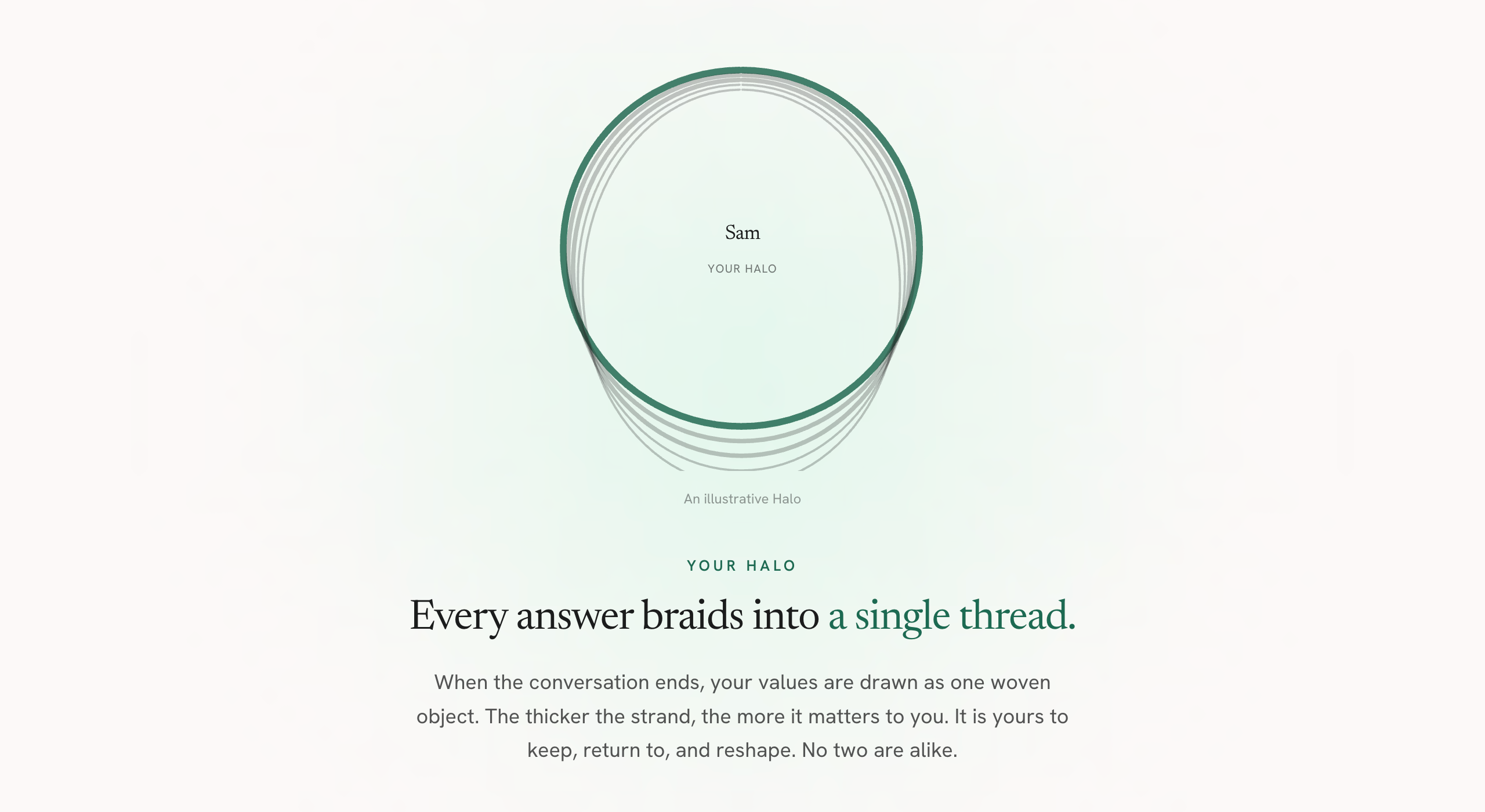
The whole premise is that reflection beats filtering. Hailo asks seven short questions out loud or in text, then draws your values back to you before it recommends anything.
I wanted the interface to feel as considered as the matching. The experiment was whether a voice-led product could avoid the default chat window and create a quieter, more reflective moment. AI tools helped me explore directions quickly, but the constraint was clear: the design had to support trust, not distract from it.
This was the eye-opener. I tried five different charity data sources; only three made it into the prototype, for various reasons. There is a real gap in enabling this kind of discovery, especially in the UK, where the Charity Commission is great if you already know the name, but close to useless if you only know the cause.
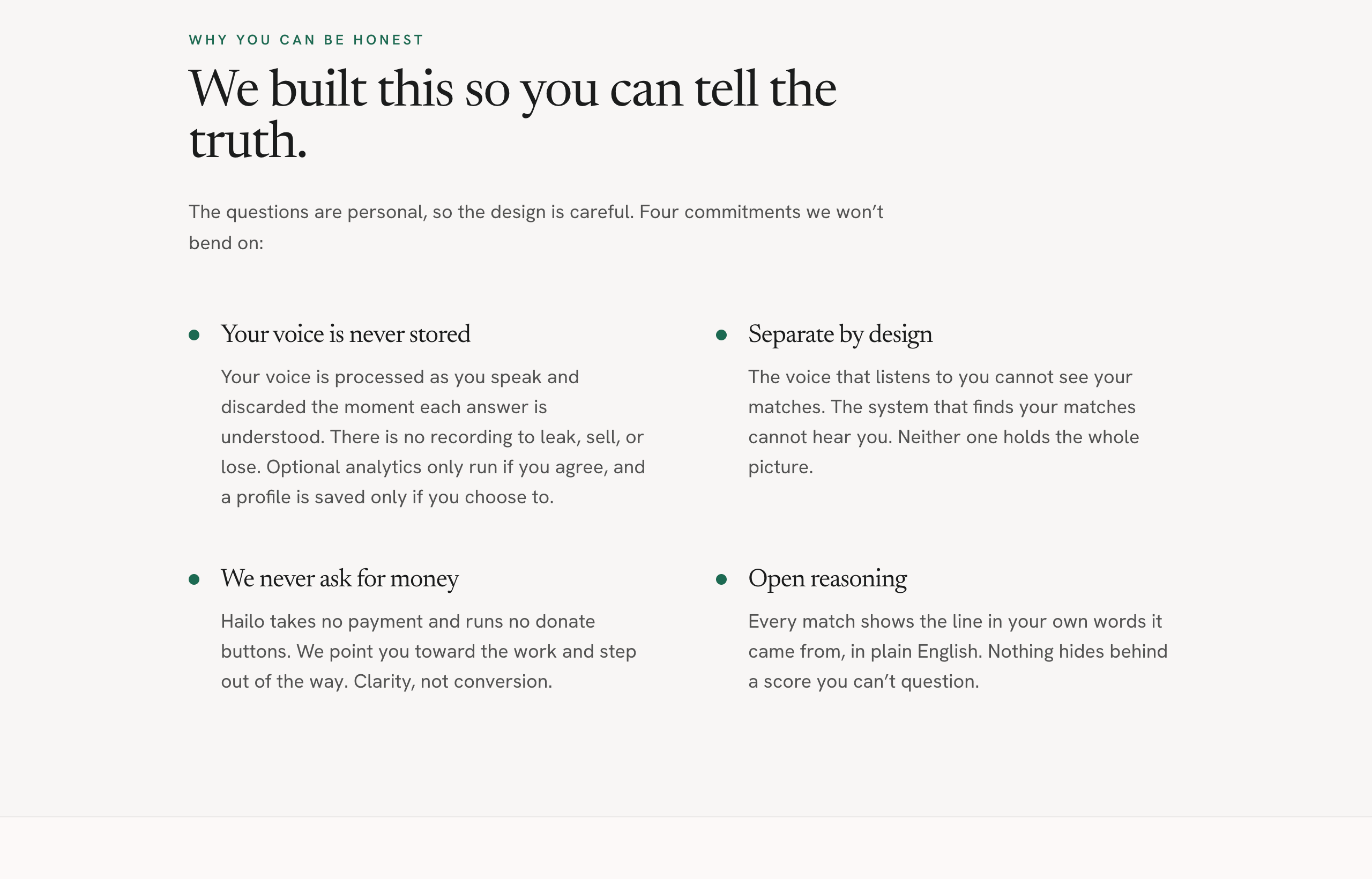
I built it as three deliberately separate agents, one for the conversation, one that structures a profile, one that does the matching, so that the part you talk to has no ability to recommend, promote, or sell. Your voice is processed as you speak and discarded; a profile is only saved if you choose.
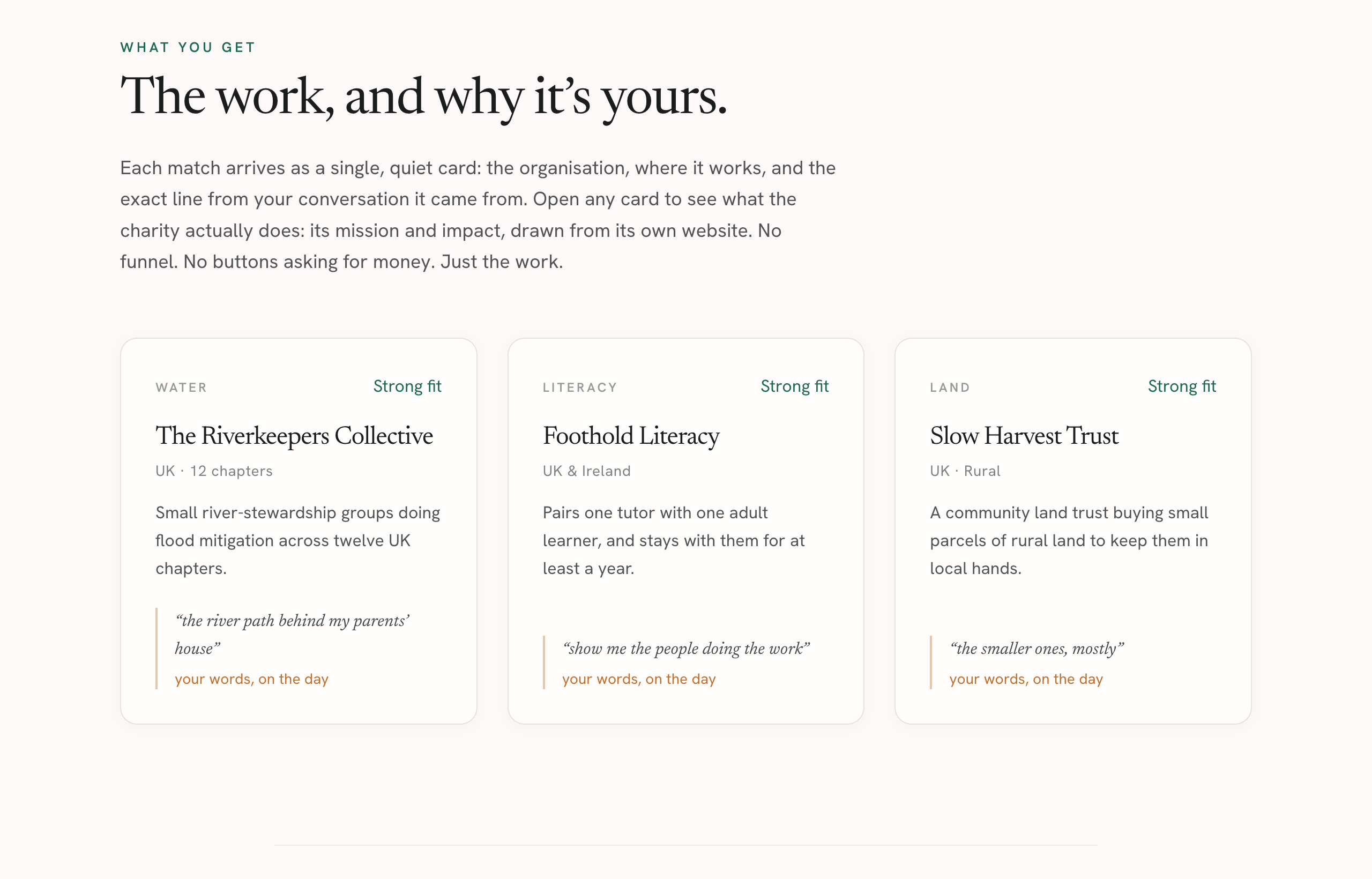
Because the questions are personal, I wanted the privacy to be a property of how the thing is built, not a promise in a policy. The agent you speak to has no ability to recommend or sell. The agent that finds your matches never hears your voice. Neither one holds the whole picture, and every match can be traced back to the exact line in your own words that produced it.
Voice is processed as you speak and discarded the moment each answer is understood — no recording to leak, sell, or lose. Analytics and a saved profile are both opt-in.
The part that listens cannot see your matches. The part that finds your matches cannot hear you. Neither holds the whole picture.
Hailo takes no payment and runs no donate buttons. It points you toward the work and steps out of the way. Clarity, not conversion.
Every match traces back to the exact line in your own words that produced it. Nothing hides behind a score you can’t question.
There are obvious directions this could grow, but I kept the first version deliberately narrow. The same interaction might eventually connect to donations, or let charities describe the moments where they genuinely fit. For this build, I wanted to test the user-facing half first: whether the discovery felt useful, and whether the matches felt earned.
That also made it a good test of the architecture. Different agents do different jobs, kept separate on purpose, so privacy and safety are part of how the prototype works rather than promises added after the fact.
I have never quite believed something like this would land, which is exactly why I wanted to build it and put it in front of real people. I am curious whether anyone would actually do it, and whether it holds up on both counts: the discovery and the matching.